
SMEs have been using AI throughout 2025, but how and what for may surprise you

Conversational AI has quickly become a practical tool for SMEs. Not the scary, world-ending version pushed by headline writers. More the everyday version that helps people work faster, think more clearly, and reduce mistakes. A single monthly ChatGPT licence can replace hours of manual activity, but like any system, the value only shows up if you set things up properly.
Recently, I wanted to understand what business leaders in Australian SMEs are actually trying to solve with AI. Not what vendors claim, not what futurists predict, but what real leaders with real businesses are asking for help with.
According to a study by Decidr and Nature, 92 percent of Australian SMEs surveyed reported using ChatGPT or Microsoft Copilot, but to what extent? What I see and hear in boardrooms, workshops and conversations feels very different.
As AI models have become embedded in daily business activity, I thought ChatGPT itself would be an interesting place to source insight. So I started digging. Going beyond the surface that paints a lofty picture, splitting SME leaders into four revenue bands between $1.2m and $50m.
The goal was simple. Identify real themes, not hype.
What are business leaders actually asking conversational AI for?
AI learning priorities by revenue band
| Learning Priority | $1.2m to $5m | $5m to $15m | $15m to $25m | $25m to $50m |
|---|---|---|---|---|
| 1. Building a usable business strategy | Want simple direction and priorities | Want structured plans with measurable goals | Want cross functional alignment | Want strategy tied to investment cases |
| 2. Cash flow clarity | Understand cash timing and avoid surprises | Build scenarios and plan buffers | Link cash flow to growth decisions | Integrate AI into FP&A models |
| 3. Marketing that works | Content, ads and messaging without agencies | Funnel performance and ROI tracking | Channel mix optimisation | Marketing effectiveness benchmarks |
| 4. Sales consistency | Lead tracking and conversion basics | Pipeline accuracy and coaching | Territory, account and pricing analysis | Revenue modelling and forecasting |
| 5. Customer insight | Summaries of reviews and feedback | Structured surveys and persona updates | Segmentation and behaviour patterns | Predictive churn and customer lifetime value |
| 6. Operational efficiency | Automating admin and service tasks | Automating workflows across teams | Process bottleneck analysis | Scaling operations with systemised automation |
| 7. Understanding numbers | P&L, margins, overheads and pricing | Financial reporting and dashboards | Unit economics and contribution margin | Multi business or multi site financial insights |
| 8. Pricing decisions | Benchmarking and margin modelling | Value based pricing tests | Dynamic pricing scenarios | Strategic pricing and elasticity analysis |
| 9. Team communication | Expectations, rhythms and roles | Performance conversations and scorecards | Cross team communication | Leadership communication frameworks |
| 10. Hiring and HR support | Job descriptions and interviews | Capability frameworks | Workforce planning | Culture diagnostics and succession planning |
| 11. Customer journey improvement | Identifying friction points | Mapping multi touch journeys | Journey optimisation tied to KPIs | Omnichannel journey analysis |
| 12. Competitive comparisons | Basic competitor scans | Category and region benchmarking | Competitor strategy trends | Market share and competitive intelligence |
| 13. Priority planning | Converting ideas into a 90 day plan | Initiative planning and tracking | Portfolio management | Strategic program management |
| 14. Forecasting demand | Short term forecasts | Seasonal and capacity planning | Cross site or cross product forecasting | Integrated forecasting across divisions |
| 15. Reducing founder dependency | SOPs and delegation | Middle management capability | Leadership cohesion | Executive team performance insights |
| 16. Risk and compliance | Policies and industry obligations | Broader operational risks | Enterprise risk mapping | Risk, compliance and audit readiness |
| 17. Brand positioning | Simple story and differentiation | Category positioning | Brand architecture | Brand value tracking |
| 18. Digital transformation | Software selection and setup | Workflow redesign | System integration | Technology roadmap development |
| 19. Customer service uplift | Scripts and escalation paths | Service quality tracking | Voice of customer systems | Predictive service issues |
| 20. CEO workflow support | Day to day decision support | Structured planning and communication | Board prep and analysis | Executive team performance insights |
Source: ChatGPT
While the themes are consistent, the sophistication grows with revenue. Strategy questions get more complex. Financial prompts shift from basic P&L interpretation to forecasting. Marketing prompts evolve from copywriting to attribution. Customer insight moves from reading reviews to predicting churn. Risk questions become more formal. Operational prompts move from admin automation to identifying cross-department inefficiencies.
Same themes. But elevated intent.
Interesting, right?
Enough for an article on its own. But it still felt incomplete. Something wasn’t matching what I see in practice. So I kept going.
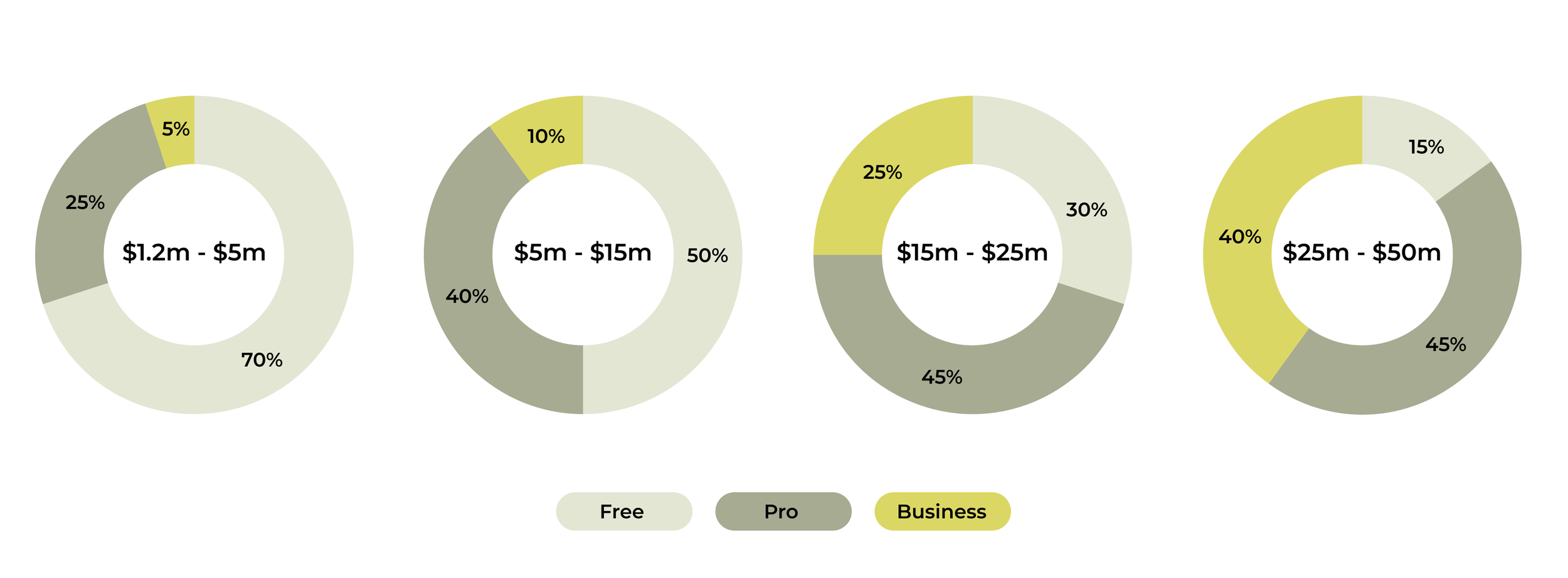
What level of accounts are leaders using?
Account type mix
Source: ChatGPT
This is where things got interesting.
Despite the risks, the hallucinations, the data security considerations and the need for proper setup, a huge number of SME leaders rely on free or personal ChatGPT accounts. This is astonishing for a tool they are now using to draft commercial documents, analyse internal data, or support strategic decisions.
It raises two key questions for me:
Do they actually know if their data is safe?
Do they realise how inefficient they might be by avoiding Business-grade setup and processes?
A pattern was starting to emerge. Leaders are willing to explore AI, but are they setting themselves up to succeed with it? So I looked at how they were actually prompting.
How are leaders prompting ChatGPT?
Prompt behaviours by revenue band
| Revenue Band | Prompt Behaviour | Typical Prompts | Depth |
|---|---|---|---|
| $1.2m to $5m | Fixing problems and getting clarity | “How do I fix…”, “Write this…” | Short and immediate |
| $5m to $15m | Planning, analysing, building systems | “Analyse this…”, “Plan the workflow…” | Medium with data inputs |
| $15m to $25m | Decision support and cross-functional alignment | “Compare scenarios…”, “Interpret the data…” | Long structured context |
| $25m to $50m | Strategic intelligence and modelling | “Model this…”, “Benchmark and evaluate…” | Complex, multi-layered |
Source: ChatGPT
As revenue increases, the prompting behaviour shifts. Leaders begin to use AI as a thinking partner, an analyst, even an informal member of the leadership team. But this created another question.
If they are prompting for sophisticated analysis, forecasting and benchmarking, are they actually getting what they think they’re getting?
This led me to my next prompt.
How do these leaders depend on AI?
Dependability trends by revenue band
| Revenue Band | Frequency | Volume | Criticality | Dependability Pattern |
|---|---|---|---|---|
| $1.2m to $5m | High but irregular | Low to medium | Moderate | Reactive usage |
| $5m to $15m | Daily for key roles | Medium to high | High | Semi-systematic usage |
| $15m to $25m | Daily across leadership | High | Very high | Integrated into operations |
| $25m to $50m | Daily across organisation | Very high | Mission critical | Institutionalised usage |
Source: ChatGPT
The initial answer I received painted a very rosy picture. Too rosy. It implied that by $15m revenue, businesses had seamlessly integrated Conversational AI into the organisation.
That’s definitely not what I see. So I pushed deeper and reframed my prompt, as you should when using AI tools.
And the reality is far more revealing.
The AI reliance reality gap
Business leaders are asking sophisticated questions, but their prompts often lack the fundamentals to get truly useful answers.
They frequently:
leave out critical data
assume the model understands their business context
ask multiple questions inside one request
skip constraints
provide vague or conflicting direction
for analysis when they really need synthesis
ask for outcomes that require human judgement
As a result, they are receiving answers that:
look polished
are directionally right
seem intelligent
but are not actionable
miss nuance
ignore organisational realities
And here we are with a critical insight:
Most leaders think the AI has done the job, but less than 30 percent of the output is genuinely useful in a business decision-making context.
The rest is, unfortunately:
too generic
blind to resource constraints
blind to culture
blind to sequencing
blind to trade offs
and blind to the messy truth of how SMEs actually work
The dangerous result is a false sense of strategic clarity short term. And long term…?
If you’re in one of these groups… you’re not alone
AI landed fast in the SME sector. One day you’re trying to stabilise your CRM, ERP, cyber security and digital marketing. The next you’re being told that teenagers are building multimillion-dollar AI businesses in their bedrooms.
The message is predictable. “Adopt or be left behind”.
So people jumped in. They tested prompts. They automated tasks. They wrote content. They asked ChatGPT to analyse things it should never analyse without the right context. And then, without noticing, the prompts escalated.
“Fix this email” turned into “Fix this department”.
“Write this post” turned into “Create my growth strategy”.
Without realising, AI tools have been accidentally creeping into SMEs cloaked as the ultimate ‘Chief Everything Officer’ delivering confident but often incorrect strategic direction.
So what should you do?
As with all of my articles, I like to give my answer to a problem. And my view is simple.
Don’t start with AI. End with it.
There’s an old saying that goes something like, ‘If you only have a hammer every problem looks like a nail’.
AI can accelerate activity if introduced correctly.
Use it to speed up processes, not invent them. Use it to inform decisions, not make them.
Use the right account structure.
This does not require big spend. Just the correct setup. Having dedicated spaces for teams to work collaboratively not only gets the best out of the tool, it ensures compliance that will help your CTO sleep easier at night.
Develop and test prompts and instructions with real tasks before implementation.
Once they work, stick to them. This is a critical investment. Sure it takes a little learning and time, but the trade off is risk.
Understand what AI can and cannot do.
It can speed up thinking and repeatable tasks. But at this stage it cannot replace judgement, alignment or strategic focus.
So can I help?
Absolutely.
If you recognise yourself in any of these cohorts, chances are you are turning to AI where you actually need real strategic expertise. The right strategy ends with AI, not starts with it.
If you’d like to talk about where AI truly fits into your business, give me a call, drop me an email, or DM me on LinkedIn.
